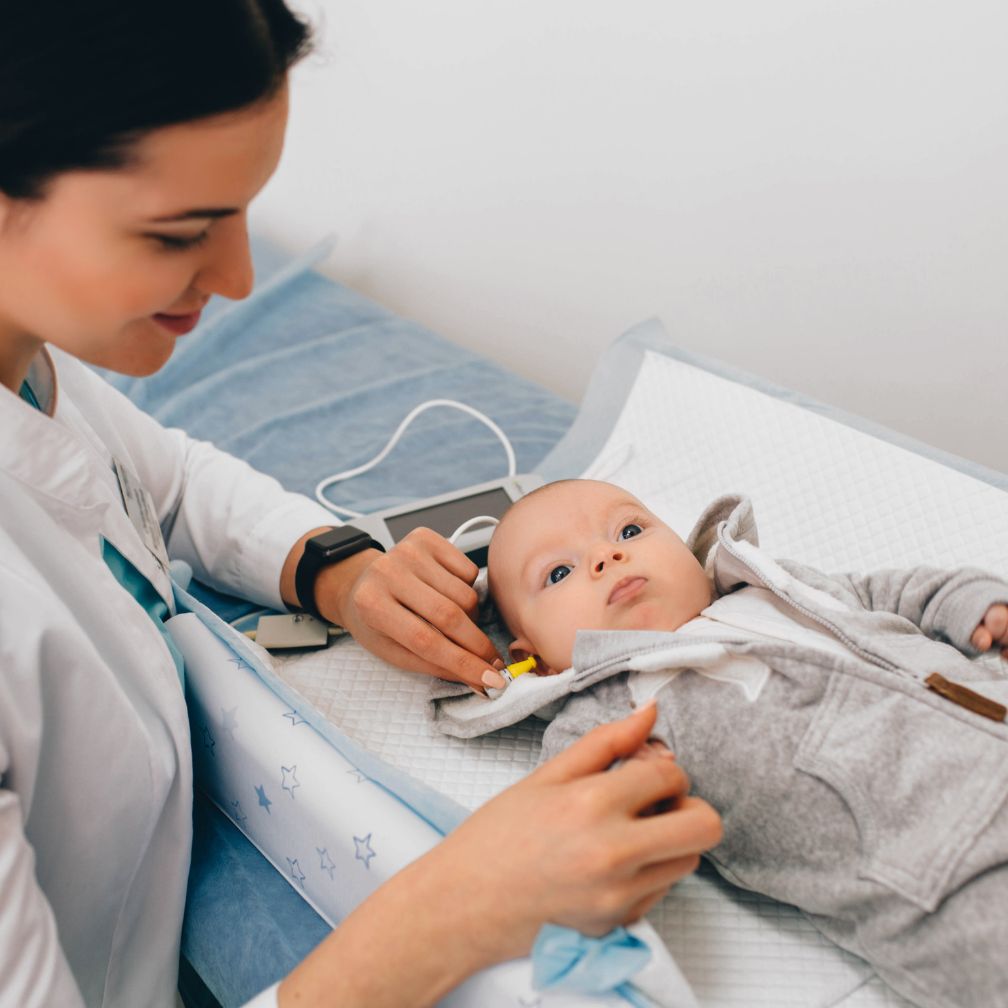
For mothers and fathers of newborns, receiving news of an infant’s hearing impairment often feels distressing and daunting. Fortunately, through prompt detection and medical intervention, young children with hearing deficits will successfully grow and succeed. Remarkably, such young children can gain verbal abilities, social skills, and solid bonds within their surroundings, cultivating a deeply rich existence!
Deploying personal hearing aids alongside cochlear implantation options offers two exceptionally successful approaches for assisting infants with hearing loss. Further down, our article reviews their functional parameters so you can determine the proper choice for your baby.
Understanding Infant Hearing Loss
Congenital hearing impairment in infants often occurs because of various root causes, such as:
- Identified genetic predispositions (even in the absence of verified familial lineage)
- Direct congenital pathogen exposures such as cytomegalovirus (CMV) and rubella viruses
- Unexpected labor complications, featuring perinatal hypoxia or preterm birth
- Particular clinical medications prescribed during neonatal intensive care
Which part of the process proves most critical? Rapid clinical confirmation. This clinical standard explains why newborns across the United States undergo auditory checks before departing the nursery. Certified pediatric audiology experts faithfully maintain the established “1-3-6” operational timeline:
- Preliminary auditory screening conducted within 30 days post-birth
- Definitive hearing diagnosis finalized prior to 3 months post-birth
- Direct clinical management (utilizing hearing tools or specialized rehabilitation) initiated within 180 days of life
Reaching these clinical benchmarks offers babies the optimal foundation for robust speech, linguistic, and neurological growth. If you seek direction concerning these newborn checks, your pediatrician will gladly advise you!
Hearing Aids for Infants
When managing infants presenting with mild to severe hearing deficits, personal hearing aids regularly act as the primary intervention. Such small, wearable instruments enhance incoming sound, aiding babies in discerning human speech and ambient sounds more accurately.
Certified pediatric-grade hearing devices stand as:
- Fully cleared and safe for infants only a few weeks old
- Engineered using soft, pliable custom ear molds that adapt as the baby matures
- Equipped with tamper-proof battery doors and pediatric-specific features
- Precisely adjusted by a pediatric hearing professional to fit your infant’s precise diagnostic profile
As your child matures, these devices demand ongoing professional tuning to ensure proper placement and accurate acoustic output.
Pediatric Cochlear Implants: An Advanced Solution
When a baby presents with severe to profound sensorineural impairment that fails to respond adequately to conventional hearing aids, specialists routinely suggest a cochlear implant. In distinction from standard acoustic hearing devices, cochlear technology:
- Require a specialized surgical operation for precise fit within the temporal bone area
- Directly bypass compromised areas inside the inner ear
- Transform ambient sound into direct electrical pulses that excite the auditory nerve fibers
Dedicated pediatric cochlear devices serve as:
- Fully cleared by the FDA for pediatric patients aged 9 to 12 months and older
- Uniquely successful when supported through early therapy programs and consistent family engagement
- Cleared only after a rigorous evaluation process by a certified audiologist and otolaryngologist
That pre-surgical path incorporates neuroimaging scans, advanced hearing evaluations, and setting realistic expectations for future communicative success.
Hearing Aids vs. Cochlear Implants: What’s the Difference?
- Mild to severe hearing challenges suit Hearing Aids; Severe to profound hearing impairment calls for Cochlear Implants
- Non-Invasive wearable design: Hearing Aids; Invasive surgical placement: Cochlear Implants
- Physical sound amplification: Hearing Aids; Digital electrical impulse transformation: Cochlear Implants
- Application starts during early infancy: Hearing Aids; Placement starts at 9-12 months: Cochlear Implants
Summary Thoughts: Supporting Your Child’s Hearing Journey
When your child is diagnosed with auditory deficits, remember that proven treatment choices and plenty of support. Thanks to collaboration with dedicated pediatric audiologists, many young children achieve speech and language milestones fully matching their playmates.
Whether your child is a candidate for hearing aids or cochlear implants, early action produces a lifelong positive impact.
Are you seeking answers about your child’s overall hearing wellness? Call our clinic today to receive a complete diagnostic assessment and personalized rehabilitation plan.